
The president’s house, erected severely at the very centre of Frat Row, glowers down at the flamingoes, tricycles, and beer cans that line the street.
Where the usual donations to other colleges come from dotcom millionaires hoping to slap a name onto a muddy plaza or concrete bench—most of the halls having been nabbed by Gateses or Rockefellers—the alumni of this school practically keep the lights on. Old boys’ money keeps the frats running, various monies alumnarum keep up the festivals, and the microscopes get fresh lenses every year thanks to the anonymous founder of a medical start-up. I’m staying at the Native House, a Cape-style cottage funded by a pan-tribal network of indigenous graduates. The powwow is tomorrow. Before leaving for the night, we listen to the old boys in the basement talking to a group of young singers practicing in a drum circle. Oh, back then? Happier times, looser discipline—bigger drums, if you’d believe it, eh. There is a brief pause. The younger men shift their chairs, making room, and the old boys take up sticks and sing.
My guide from the house is Navajo-Vietnamese. She’s about four-foot-nothing, with the intelligent gaze of a fixer. I get the sense, throughout the mad night that follows, that she is subtly greasing the wheels for me: explaining my accent, mollifying the lanky bouncers, excusing my disgraceful Pong performance. On the first night, I hold it together: we sweep delicately through the packed corridors of a fraternity, nicking and necking a few acrid potions of eau de métal from the bedrooms that the brothers have converted into bars; upended bedframes with two-by-fours strapped to the sides and dressed with tablecloths covered in lewd graffiti. We leave after almost exactly one hour, bound for diversions, pong, and music.
One of the most hallowed events in the college’s social calendar is known as Lingerie. Of dubious origin, the tradition now involves a variety show featuring scantily-clad—though not nude—amateur performers of all kinds. We arrive for the final third of the show. The room is dark and oaken, lit by its corners in gold and pink. It smells like warm seltzer. A crowd of almost a hundred sits cross-legged on the floor, watching a dark-haired senior on the stage. Guys, she says, I’m gonna speak my truth: I hate men. There is a mixture of cheers and cackles from the audience, the blokes maintaining even grins. The performer immediately tears off what few outer layers she has on and begins writhing about the stage floor to Chappell Roan. Leaping to her feet, she stumbles backward and breaks the hitherto unutilised stripper pole with a crash. Raucous applause. She is followed by two shirtless guys in cheap golden neckties, who produce a flourish of card tricks before casting their unlooped ties into the crowd and performing a dance routine best described as consisting primarily of mimed, acrobatic love-making to a pair of chairs. Following this, there are various vocal acts of indiscernible merit; the tannoy crackles and muffles as the performers appear increasingly determined to swallow the microphone. One of the final acts is a very nervous Asian sophomore, whose stand-up routine mainly involves, so far as can be made out, digs about lesbian astronauts. …I guess the faggots ARE criminals, then! he stammers, after an unintelligible setup. Some uneasy chuckles. A wan salvo of nervous lip-widenings is shot about the room; one of my neighbours audibly gulps. The air is thick with sudden gaydar pings. Results inconclusive. He is shirtless, but in such a setting that’s no guarantee. Ah well, we think. We suppose he probably can say it. He is given polite applause, and our party slips away before the clock strikes eleven.
The college claims to have invented Beer Pong. When women were first admitted some time in the seventies, the male students snapped the handles off table-tennis paddles. This was only after an extensive campaign of misogyny in that special flavour that passes for American blokery; the gripless paddles were final, desperate Panzerfausts pressed into the hands of frightened boys in defense of a crumbling and orgastic empire. A woman’s hand was thought too small to hold the whole paddle. Bloody hell, I pant as another grinning nineteen-year-old girl sends a lightspeed orange blur whizzing past my ear, it having first delicately clipped the very brink of the beer-stained table before me. It’s a good score for the dignity of women that this game of handleless Pong, nowadays stuffed full of bizarre rules in an effort to rehabilitate the sexism, remains so popular, egalitarian, and damned good fun.
As the hour at any given house party draws closer to midnight, the probability of somebody playing Mr. Brightside approaches one. The fraternity band rockets into the tune at 11:56pm. Fronted by a very earnest ginger sophomore, the cymbals are far too loud and the guitarist insistently slurs his riffs. The audience bounces cheerfully—though the frantic enthusiasm from vodka and pingers is beginning to wane—and individual dancers are picked out of the blue by pink spotlights. As the band finishes and we leave for the sorority, we pass a note scribbled in black marker on a wall:
I am going to explode right here and right now. An epic, fiery implosion corrupting this house—causing descent into chaos. -[REDACTED]
As we walk, my guide intimates to me that she is part of a secret society. With the apparently full sorority social schedule—participation mandatory, lest a sister lose formal, committee-allotted status points—I wonder how she manages it. The society buries plastic snakes and notes near the gate to the graveyard, next to the first gravestone. The stone simply reads Mom. How beautiful, I think. It seems to defy the nature of memorials; they’re supposed to commemorate a particular person, from a particular time, in order to ensure a particular immortality, aren’t they? This, instead, is a totally relative memorial, one existing out of time. It was Mom then and remains Mom now. We reach the house, the cheap marble countertops glistening as if in a showhome. The night ends on the sorority rooftop, in the glow of cannabis cigarettes from Vermont.
The next morning. Grey drizzle at the Grand Entry. Our young singers from the Native house are nervous, and their rain cover droops on one side. There are Southern Cree singers here, celebrities in Indian country, sitting coolly in the neighbouring tent with rain bespotting their dark sunglasses. We stand across the arena on the bleachers, a Jamaican bloke from the business school standing beside us. Taut forearms, big gold watch. I tell him that I study trees. He nods, and tells me a series of utterly fascinating things about the scent of cedar. I notice, at this point, that he smells very pleasant. I ask after the source of his fragrance knowledge and he tells me, in a rich mahogany baritone and with a misty look into the near distance, I have interacted with a lot of lumber. Our singers start up, and the Entry begins.
Later, a party. A bounce of curls, a banister-brown hand. An exchange student! Turkish. Whakawhanaungatanga to be approached delicately. A few beers deep. Hey mate, howzit, ever hear of, ah, shit let me look it up, Kemal something… Atatürk! You know him, aye? Yep. Yep. All right man, have a good night. Just so. Next, I catch a ruddy ‘ehu boy sinking something fizzy and aluminium at the base of a stairwell. Our drunken hybrid of honi and hongi leaves my forehead a bit red. I’d never seen so many Hawaiians in the same place, much less the backwoods of freezing New England. Are you from Aotearoa, they all ask. Yes, I answer. Lastly, I am introduced to an Olympic athlete. She’s an Olympic athlete, says my guide, helpfully. Hello, I say. I smile, but it's at this precise moment that various lines begin taking their responsibility to converge on a single horizon somewhat less seriously, and my charming smile takes on a certain droopiness. My guide grins soberly. Nice to chat, then.
It’s no surprise that these kids play hard. Tuition at the graduate business school is $250,000 for two years. This is thought to be quite steep, compared to the mere $100,000 that undergraduates pay each year. There is some difference between the two groups. It is not unheard of for business students to arrive by private jet, whereas last year, an undergraduate stepped straight off the Appalachian Trail with belongings in tow and immediately moved into his dormitory. The business school smells like a dry sauna, and is designed like a Scandinavian capitalist treehouse. Trading terminals cluster in rings lit by the soft neon lights of wooden basement rooms, each with a corporation’s name on the door. There are other schools; the engineering and medical students are seldom seen, except at annual functions notorious for indecorous performances of undergraduate alma maters. Whatever their field, graduates and undergraduates alike are usually in class from eight o’clock till five, followed by dinner and an hour or two of study. They’re drinking by seven, and the ‘Good Sam’—alcohol poisoning—calls start rolling in to campus security by about nine.
This ruthless efficiency defines the nightlife. The frats and sororities have a network of bosses that run the social scene. Every evening, each boss texts the group chat with a list of events taking place that night. bombs @ zete at 9:30! country @ chi gam at 11! show groupme at door to be let in! Each fixture is run like the navy: pissup starts at 7 o’clock, pong at 9, dancing at 10, paint party at 11, finish the night at a gig at 12, home in bed by 1am. Of most note here is the first stop: I've never seen predrinking performed with almost automatic stamina and determination. Drinks flow from an inexhaustible, alumni-funded fount into tiny plastic shot cups, fizzing and burbling in colours hitherto undreamt of by man. The houses are enormous and basically unfurnished, all the better for the movement of the crowd. They’re covered in graffiti, from the foyer to the basement, and between the DJs and infinite piss the effect is entrancing. I couldn’t decide, when asked, what we back home could learn from these parties—or, indeed, what the hosts might learn from us. The key is having an organised network of houses within walking distance, I venture. It’s a very fun approach to partying. High energy, quick tempo, never gets old.
There is one strangeness to the parties, though. As the rooms begin to spin, I try to put my finger on exactly what is unusual, and I eventually realise that I haven’t seen a single couple kissing. Or holding hands, or showing any affection whatever. Odd. Back home, one takes for granted a few public pashes, an indiscreet hookup, the clink of a belt buckle from a minor bathroom. Not so here. It’s actually difficult to determine whether the men and women even know each other; despite passing through at least ten venues, I will fail to identify a single romantic couple the whole weekend, and not once will I see anyone obviously hitting on anybody else. I will realise that the objective of all this is to create a party scene of individuals, every element of it designed to streamline each person’s own experience of getting utterly mortalled. It is as if a kiss would break the spell, to drag one into the messy world of feelings and questions and horniness, quite against the fatigue and stupor that the machine is supposed to induce. Everything, the drinking, the moving, the deafening music, even the temporary, drunken love for one’s fellow man, is designed to overwhelm the individual and send him to bed with a warm, fuzzy, chemical exhaustion, all the better to get him up for class the next morning with all capacity for social feeling pleasantly wrung out of him—at least, until that evening.
Over the course of the weekend I am asked on no fewer than five occasions about the suicide nets on our bridges. That's all people know about my university; that we kill ourselves. This is strange to the adonic, marble-jawed youths who question me as I sit on the floor of someone’s bedroom. Why would anyone dislike university?
I don’t know what keeps the old boys and girls—and their capital—coming back. It’s not as if the college is always the almissima of maters; a bloke died a couple of years back, and bequeathed for the school golf course a few small millions which the college, having decommissioned said golf course a year before his death, nonetheless took his widow to court in an effort to get their paws on. I don’t understand precisely where the community comes from, or what function the headrush nightlife plays in making this place special to those who attend, nine in ten of whom end up as executives within a decade. Maybe the woods, maybe the four-hour drive to the nearest city, maybe the tiny population—maybe none of these things. My best guess comes from a single doodle on a wall in the beer room of a fraternity basement:
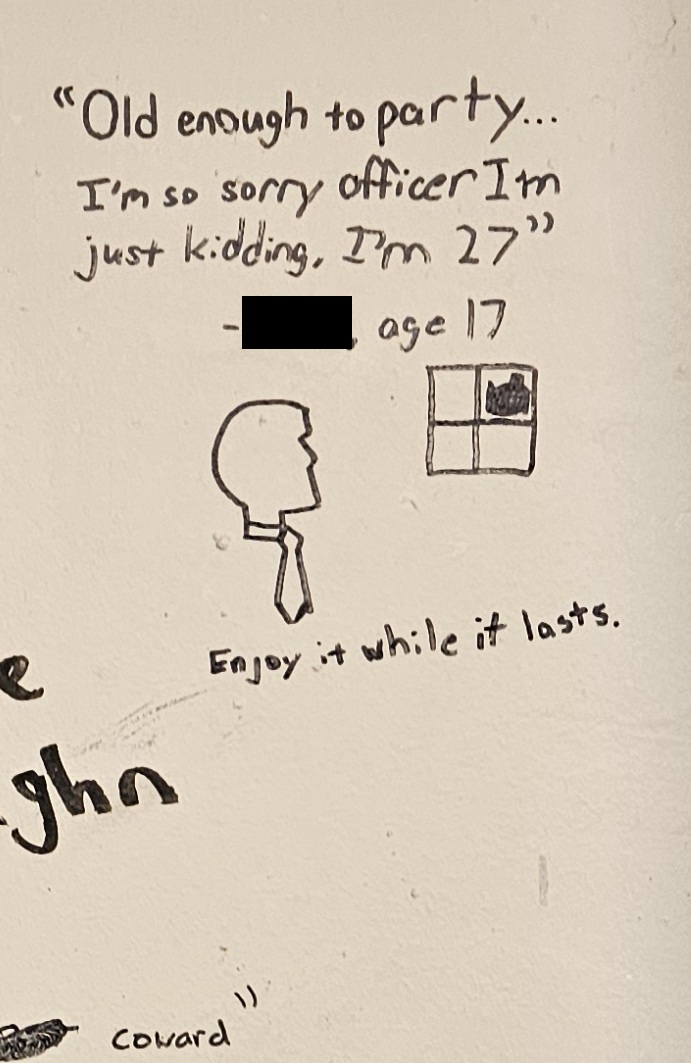
The isolation breeds a self-conscious community, all knowingly embarking on the best years of their lives. You know your time here will end, and your only chance for immortality is to live through those who will follow you. So you donate, you come back for powwow, you tell stories about the old days, and eventually your children do the same. Maybe if you, and they, and every one of your old buddies keep coming back, the golden years never have to end.