
Adapted from a series of online conversations held January through February. Various friends shamelessly plagiarised.
I. Horror
Most of the haunting comes from the landscape. It’s a huge, empty vastness looming in the mind; unexplored except for the mines and the pipelines and the cities and the roads. It’s permanent, timeless, virginal, yet to be mastered. What's more: there are still Indians in the woods.
My friends upstate told me about the asylums. The only horror deeper than that of the wilderness without is that of the wilderness within. One imagines exquisite medical cruelties that stain the corridors and cells, mad wailing shades burnt onto the wainscoting in gnarls of shoulders and knees. It is only reluctantly that the dour landlady charges $25 for a tour; on thine own head be it, says she—if not in so many words.
Yet the outside bleeds in. Certainly, the old caretaker committed suicide on the third floor, but the asylum itself was built on an old Cherokee burial site. Surely, the ghosts of patients past scream in the night, but sometimes the screams are in Onyota’a:ká. Verily, the wilderness is empty, in space and time, but haunted—haunted by a long-since-made Choice, made by the old folks and carried by those who remain. Who killed all those Cherokees? And, come to think of it, who paid for all those asylums?
A friend told me that, nowadays, nurses around here can qualify entirely online. Such a thing simply shouldn’t be allowed. They should have to do their residency in the Sudan, near the banks of the river where the flies don’t go. They should have to treat wounds so red and so deep that the stains turn their frocks a gentle, mocking crimson. And to hear moans that’ll echo in the corridors of their suburban homes for their children to hear, to remind them of the pain fleshed into their mothers. No TikTok dances, either; it’s unbecoming.
Abstract fears of the wilderness are routinely transformed into a quick buck by predatory occult wankers. Psychics aren’t real, obviously. At least, not the sort that advertise on the moulting classifieds boards at supermarkets. There are other sorts of psychics. Professional seers? Exclusively charlatans or self-deluding loonies. Elderly aunts and uncles with unusual foresight? Worth entertaining. A great-grandmother of mine used to talk to Kopa, the white owl, a totemic guardian of my people. He’d perch on her fence as she weeded the garden beds and they’d converse. In a healthy society, the supernatural would not be found in the asylums, but on grandmothers’ fences.
The virtualising of horror in the New World is an ideological operation par excellence, and we’re all poorer for it. The horrors of the wilderness must belong to an inevitable past, because otherwise the Choice could still be re-made. Americans fear the woods, because they’re filled with the guilting, blaming ghosts of the Indians. Americans fear the mad, because no explanation will satisfy them. The hauntings by the wilderness will continue, because the the claims of the unforgiving past and the unsatisfied present are not rightly settled. Instead, living room walls flicker with Ghost Stories and every girl is fluent in therapyspeak by the time she’s twelve. There’s a ouija board stashed beneath the sofa. So it goes.
II. Fieldnotes
It was a trope in the 1860s, so common as to be a cliché, for a ‘New Zealander’ (read: Māori) to visit the ruins of London and contemplate the decline of imperial civilisation. In the style of someone else’s version of my ancestors, therefore, what follows are my own observations of decline in the metropole.
Firstly, there needs to be an erratum of these fullas’ constitution, I reckon. Life, Liberty, and the Pursuit of Lawsuits would make for a better fit. A friend was explaining to me that she has to fill in an enormous form for approval in order to work remotely from a location not forty minutes away from the usual place she works remotely. So far as she is concerned, this is totally normal, and she can’t understand why I'm baffled by it. To say nothing of their own, very nasty history, Southerners did correctly diagnose the Yankee character: rugged, independent mavericks who are in actuality total rule-followers and miserly fascists. A lot like the Australians in that regard; thinking oneself a larrikan whilst handing out a Council ticket for berm infringement. My mate Bunny says that the problem isn’t that they’re descended from convicts; it’s that they’re descended from gaolers. It must be the same here: descended from Puritans, not frontiersmen.
It’s not obvious to me whether such a parallel exists between my own nation and somebody else’s. On the present trajectory, Australia will have culturally diverged (read: Americanised) so much in the next ten years that the ANZAC ethic will be effectively meaningless. Tall Poppy Syndrome is already on the way out; we’ll miss it when it’s gone. One interesting candidate group (per Bunny, again) is the Argentinians. On the surface, it’s fairly simple. Beef, lamb, and wine exporters, rugby-playing, Patagonia looks a bit like Waiouru. There’s probably a deeper historical argument to it, too: we’re both agricultural states abruptly introduced to the entire world during the height of nineteenth-century free trade. There are certainly cultural differences in character—the reticent Polynesian versus the excitable Spaniard—but it may well be time for Aotearoa to seek kin from farther afield than the Tasman Sea.
Returning to the metropole; one interesting component of America’s contradictory national character is that there remain here living human coelacanths from each period of the nation’s history. There are fully unassimilated Mayflower oarsmen in Appalachia who functionally do not live in the United States. Amish buggies regularly rattle down to my local farmer’s market to sell apple cider to the townies, whom they call “the English”. There are still a few hippies around, although the preps have pretty much disappeared. It’s fascinating for a nation’s history to rise upward by local gradations; an uneven sort of topography, forced upwards in rocky cants by implacable subduction.
The element that ties it all together is obviously the Protestant faith. I was subjected to that new Knives Out movie the other week. It’s lit and shot in such a way that it is impossible to escape the conclusion that the guiding principle of its production design was TikTok clipfarming. It’s interesting to see so much churchslop on the airwaves (in the feed) these days. A friend and I theorised about why this might be:
K: “No press is bad press for the Evangelical Ethnostate complex.”
N: “Exactly. It's scary here. I have absolutely no doubt that the top ghouls at the white house were sitting in a circle praying for their Christian warriors whilst they were flattening Caracas. Their top propagandists insistently speak in Evangelical terms. Hollywood is manufacturing consent for crusaderism. However "critical" a film is about the Church (Conclave, Wake Up Dead Man, etc), audiences still leave understanding increasingly the vocabulary, ontology, and theology of the Church. It's like The Crown; nobody watched that whole show and became less monarchist. Whatever the setting, the nature of narrative means you must sympathise with certain aspects of the characters' plight.”
This all goes without mentioning a general return to faith and idealism since the end of the Long 2014. It would be not only impossible, but unthinkable today to elect a Trudeau, an Obama, a Blair, a Clinton, an Ardern, a Gillard. It’s hard to pin down the exact moment of the Zeitenwende; it could be the retreat from Afghanistan. It’s a time of the Will, and a resurgent evangelicalic establishment battles a wave of reactionary new converts for the ear of Western governments. Both seem able to get it.
Some more secular observations: slop is out. Liberalism is out. Woke is done. Everybody with any political opinions of any sort under the age of 30 is anti-technocracy or anti-establishment in some way. Art is in, class is cool again. What in 2014 was a fringe ‘dirtbag left’ is now the minimum viable position for having Good Takes online. Culture writers churn out screeds about Silicon Valley's obsession with "agency" and the fear of the Great Bifurcation. You can, we are told, just do stuff. The tech-bros are reinventing meaning from first principles at Burning Man. Resurgence of national and regional identity, but a new universalism in the academy. The slow return of romance.
Naturally, it’s the political right who most naturally lay claim to these urges. Reactionism is inherent, and explicit, to the present cultural moment, but it’s transduced in rather unusual and surprising ways. The incoherent jumble of ideologies represented in the current regime has been fairly well-canvassed, but it really is remarkable how even the hyper-capitalist Silicon Valley ghouls increasingly speak in comic-book-villainese:
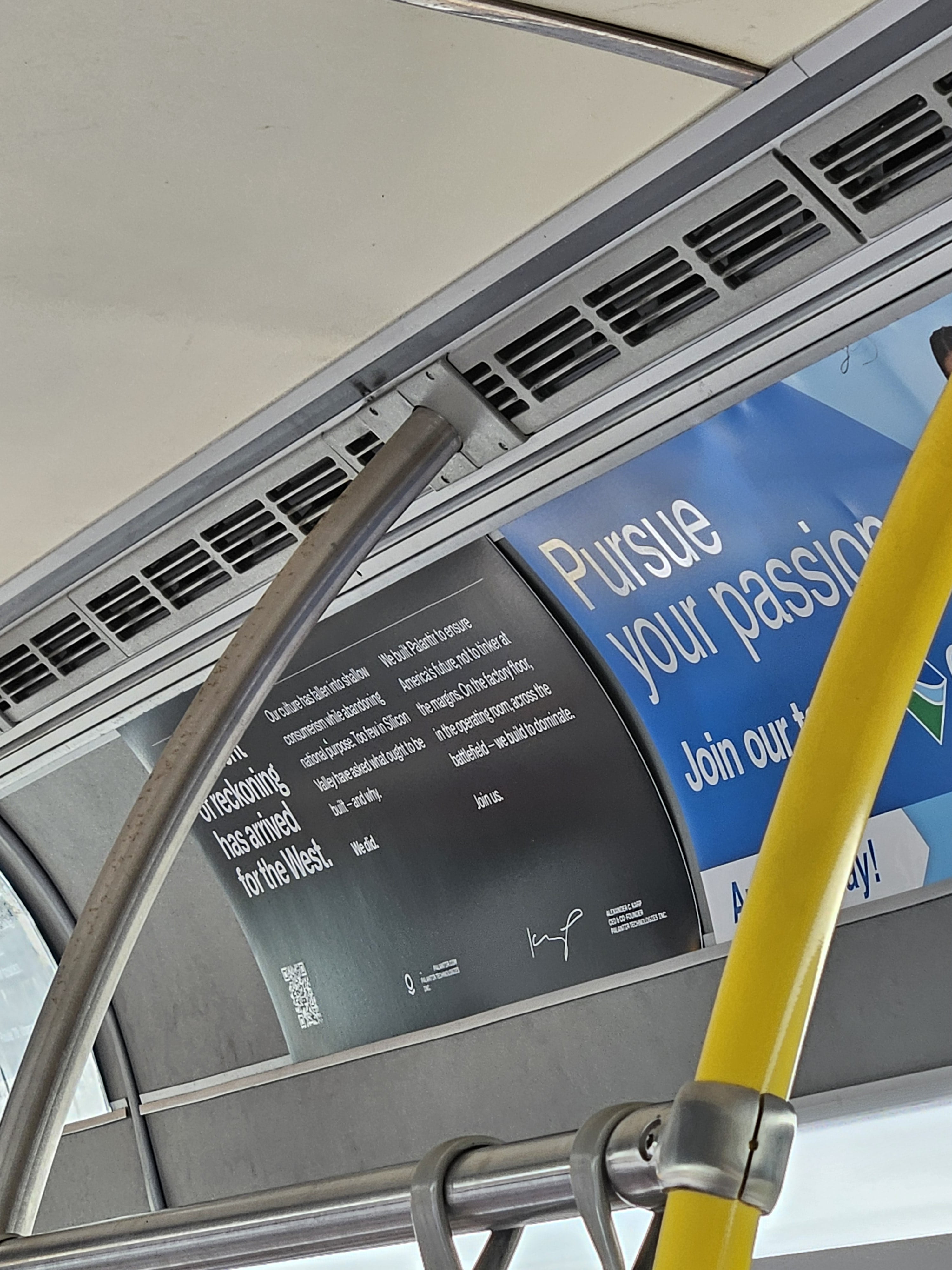
This appeared on the bus to university one morning.
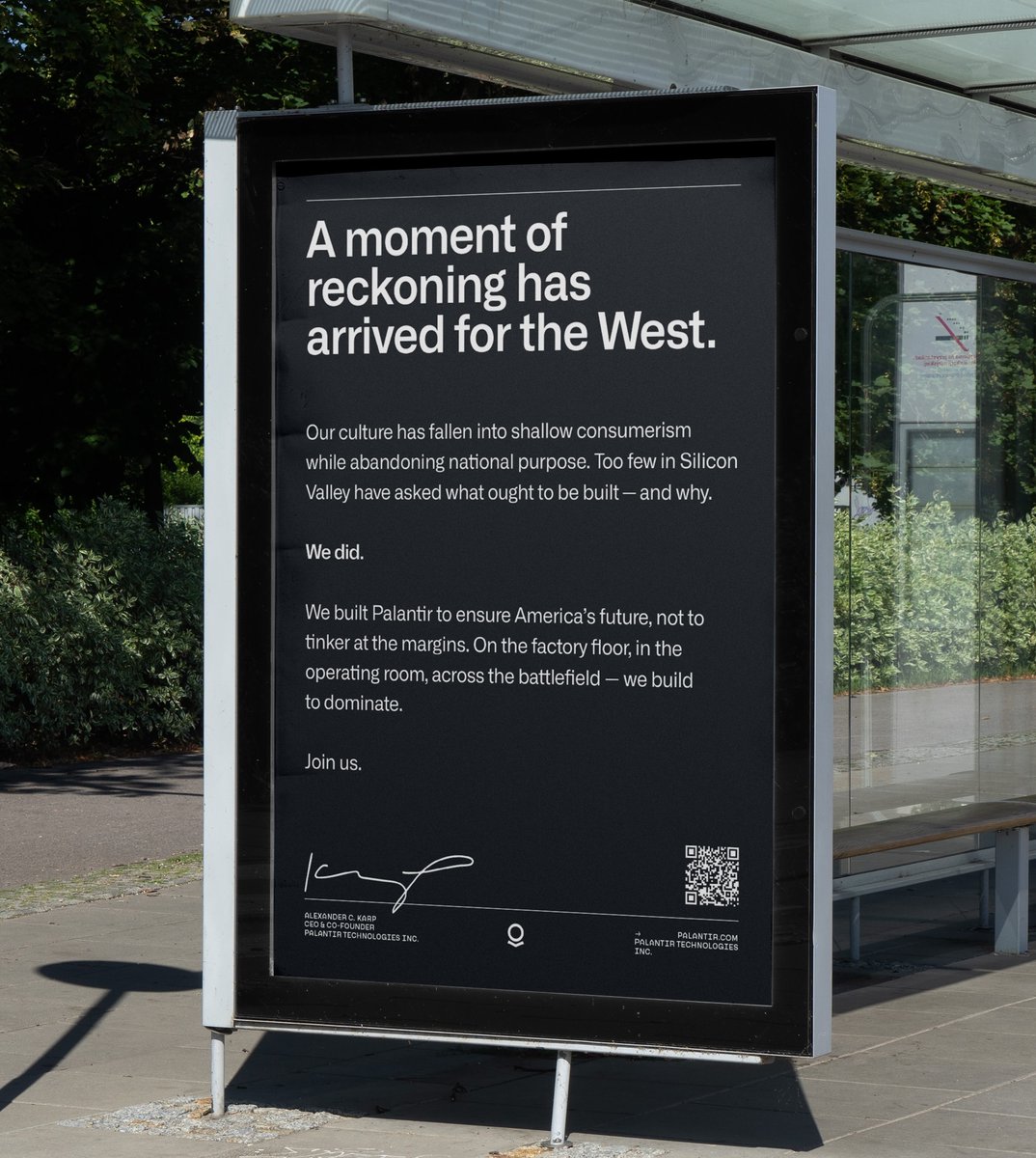
The problem with such coalitions of hyper-modernity is that they’re fatally unstable. For one thing, they result in such utterly contradictory and confused policy that they fail to achieve any goals except aesthetic ones. For another thing, they eagerly bring into their tent those whose business undermines their supposed goals; the same people doing televised bench-presses and Great Power rhetoric are those eagerly hiring San Francisco vampires to mass-deploy private AI into national industry and defence. This form of weakly agglomerated power is definitionally, ontologically incapable of conducting revolutionary activity; the aesthetic is the goal, mobilised to naturalise and obscure the restructuring of whatever civil society may remain, in the pursuit of a single politic of Notion. A vibes-based order. It’s a cult of personality without a person, a society entirely driven in service to a cartoonish icon of its people, and so long as every operation of the state aesthetically serves this virile, agentic, priapic Notion then the productive foundations of the state can continue being subducted and hollowed out. The regime does not and cannot do what it says on the tin, any side of the tin, and no constituent part of the regime is actually winning. It is utterly doomed to crumble.
Therefore, it can be said categorically: the political right is wrong to claim that they possess 100% of our culture's revolutionary energy at the moment. From the Substack intellectuals to the lumpenproles who still believe in ‘draining the swamp’, this fantasy relies on the aforementioned, peculiarly American delusion of being both the maverick and the master. So long as this delusion remains contained within America, and does not reach a level of critical penetration in Australia and Europe, the regime of the present White House will be unable to spread its influence except by force. The most successful leftist project to come will harness this state of affairs. It must do this not merely by exposing its central contradiction and failure to deliver on its Notion, but by actively and insurgently creating the conditions wherein warfare on the soul is impossible. A simple slogan: "Out with slop, in with life."
III. Romance
It’s important to live the life you think you want before making its universal application the central objective of your politics. To that end, I am involved in the most deliberate, teeth-grittingly determined campaign of living romantically that any man can undertake on a regular wage.
Stockbridge is a town of old Massachusetts. Bits of it escaped the last century; other bits are still catching up. The town and its surrounds are strewn lazily about the rolling slopes of the Berkshires, and populated by writers, farmers, and artisans. There are many antique stores, patronised mostly by prosperous gays. Its fields remain gold, even in the winter, scored by rows of birch and dried corn stalks. As you explore the surrounding hamlets, you may happen upon a large castle tucked behind a bend in the road. It’s owned by a bloke who made his fortune painting rabbits, or something. There’s no profound insight to be found in Stockbridge. It’s just beautiful.
Given the aforementioned antics of the regime, it’s become embarrassing and unsexy to speak of the world with Great Power rhetoric. It’s much better to do punchy oriental histories of present-day occidental affairs: Canada to share in Mandate of Heaven. Warlord Dong Fordeng secedes from emperor Kang-Nih, takes the Steel Panda Legion south, threatens spillover of conflict into the border regions of the Eagle Empire. 256 million perish. My flatmate and I had this girl over the other night; we spent the entire night repeating the phrases "you've met me at a very Chinese time in my life" and "I hear the voice of the Party". We listened exclusively to Chongqing rap and got really drunk on this evil Ecuadorian spirit called Zhumia that he had got for $8 in Cuenca. We would say "-500 social credit" whenever she said something and she ended up leaving at about nine o'clock. The unipolar world is utterly without a sense of humour; it’s pleasant, in this sense, to be cracking dumb jokes during its decline.
Some of my friends have begun to talk about their romantic conquests in increasingly geopolitical terms. My wise lesbian friend L recently informed me, narrowing her eyes knowingly like a scheming princeling, that “the friend of my friend is my girlfriend”. Friend groups in the spring are like warring states, trading lovers like castles, competing to amass the greatest body of disgruntled exes. Whole new routes are proven around campus to avoid (or run into) a particular young flame. It is to the detriment of the world, I think, that this skill is largely forgotten by world leaders by the time they’re old enough to hold office.
Poetry's got harder. You can (and should) blame romantasy for a lot, but for nothing else does it deserve more loathing than for having made it utterly impossible to describe women in poetry with floral metaphor. Everything ends up sounding like an unpleasantly intimate euphemism. My mate Bunny reckons it’s a chance to break new metaphorical ground: rock imagery. Trees. XBOX 360 controllers.
“like trunk of steady longleaf pine
thou art my onyx joystick grey,
thy hitbox overlapp't with mine,
thy Live subscription I shall pay”
In town, just off the main strip, there's a store whose stock is composed entirely of novelty lamps made from amusing objects. Occasionally there's a very severe sign in the window with something like "Stock is LOW and I am ON VACATION. Store CLOSED until next week." Somewhere, Bunny read about a designer who liked to read fifteen-year-old fashion magazines, just to catch old ideas at the height of their unpopularity. It’s well, and inconveniently romantic, to think that this person might be doing the same.